Tragedies and disasters are ever present, and in the Internet age they are much harder to escape as you now have access to an entire world’s worth of news.
There are so many that nobody can pay attention to or care deeply about all of them.
So why do some stick in your conscious, and others sail right by?
It’s hard to say, but I presume it’s a mixture of things including: what the media focuses on, what media you consume, does the story connect with something in your life, do you have time during that tragedy to focus on such event, are your friends talking about, your own biases, etc. etc. etc.
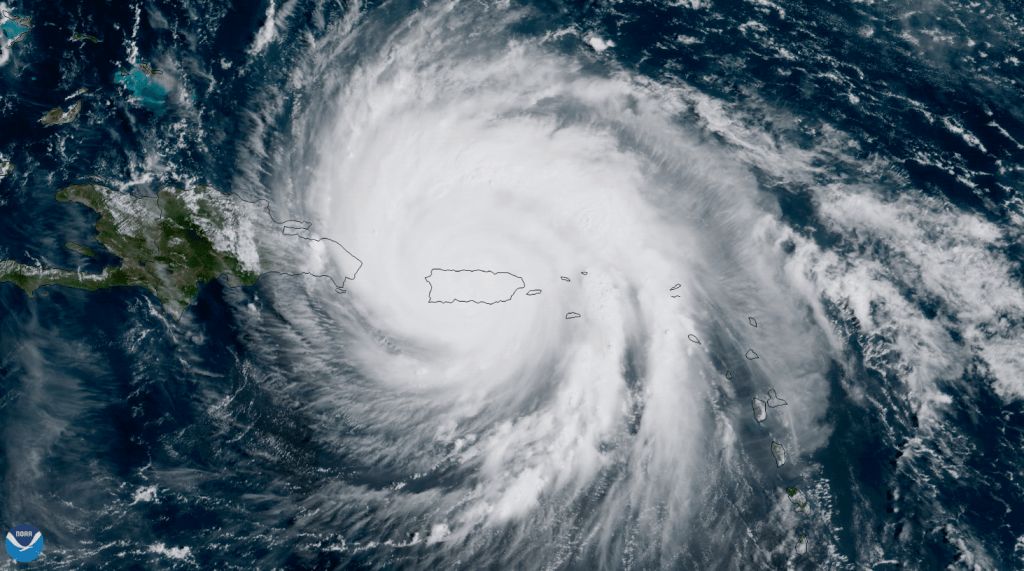
One such disaster for me was Hurricane Maria.
Hurricane Maria has always lingered for me, like a shadow I can’t escape. I’m not sure why. I think I remember my dad mentioning the injustice of it a few times, but I’m not even sure of that, and I’m not confident a college me would’ve listened. Sorry, Dad.
For those who don’t remember, Hurricane Maria was the third and forgotten sibling of a package of three hurricanes that hit the United States in 2017. Hurricane Harvey hit Houston first, then Hurricane Irma hit Florida, and ending with Hurricane Maria and Puerto Rico.
Of the three hurricanes, Harvey caused the most damage (Harvey $128.8 billion, Maria $92.7, Irma $51.5), but Harvey caused only 89 deaths compared to 2981 with Hurricane Maria1. Granted, the death toll in Puerto Rico was a hotly debated topic and at the time, their government reported numbers in the 60s, but most people considered this a large undercount2. Even if you put the deaths aside, the research organization, Rhodium Group, concluded that Hurricane Maria had caused America’s largest blackout and the world’s second largest blackout to date3,4.
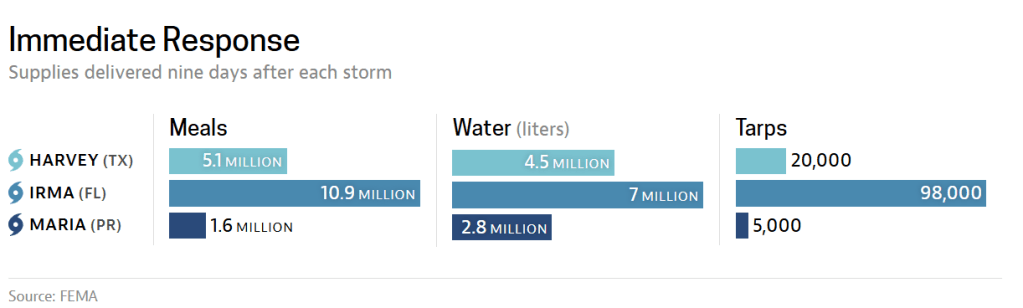
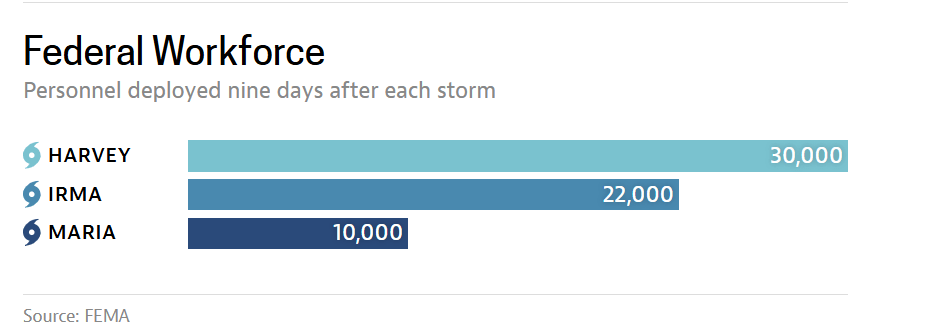
Despite all of this, FEMA’s response lagged in Puerto Rico5:
But why did Hurrican Maria stick for me? Many things happened in 2017. Hell, just a few weeks after Hurricane Maria, a gunman killed 60 people in Las Vegas, and I didn’t even remember that event until I Googled “tragedies in 2017.”
If I had to guess, I think the blatant injustice of it struck a nerve. That there were two other hurricanes, yet it felt like nobody cared about the one that took the most lives.
The best analogy I could think of would be if someone beat you up and then gave you $10 as compensation. You’d think that was a shitty deal, but $10 is better than no money. But then imagine you saw the same person beat two other people up, except he didn’t break any of their fingers or teeth, and gave them each $20. Now you’re pissed off about being beat up, and that you were given only half the amount of money as somebody who doesn’t have to go to the dentist like you do.
On top of all that, imagine you spoke a different language than everybody else, your skin color was different, the person who beat you up wasn’t even aware you were American, and that was what I saw with Hurricane Maria.
The in-your-face injustice of it coupled with the tragedy is why I think it stuck in my craw (whatever a craw is).
Of course, a neutral observer may say there was disaster fatigue, and it’s harder to get supplies to an island, and I think those have some validity, but when President Trump feels comfortable taking 13 days before visiting Puerto Rico, compared to 4 days for Harvey and Irma, or is more focused on tweeting about NFL players kneeling than Puerto Rico, you know where the political will is5,6.
And this wasn’t just a governmental lack of concern, because charitable donations followed FEMA’s suit1, and it felt like JJ Watt raised more money for Harvey than all the donations for Puerto Rico combined (definitely not true, by the way, and I admire JJ Watt for the record).
This injustice, of the discordant responses from government and charity towards Puerto Rico, was what led me to write my book, Who Do You Help?.
And yet, you will see no mention of a hurricane in the book.
But it is set in 2017 for a reason.
When I first began writing Who Do You Help?, I tasked the main characters with answering the question of how to help the most people they could with Mr. Jones’s lottery winnings. My original plan was for them to strive to answer the question, but find themselves stumped, only for them to learn about the charitable gap in donations for a fictional version of Hurricane Maria and then give the money to a fictional stand-in island for Puerto Rico.
Over time, I realized such a conclusion would be disingenuous to all the hard work these characters put in to solve the question, and with each draft I subtracted more and more of this plot out of the story until it was gone.
It’s not that I don’t see the tragedy of Hurricane Maria as still important, and I do sometimes donate to disaster relief, but disaster relief is often less organized and it is harder to know how impactful your money is. I believe in giving to disaster relief, but I don’t believe, if you are privileged enough to be able to regularly donate or won the lottery like Mr. Jones, you should make it the cornerstone of your donations due to it having less built-in infrastructure. After all, it is disaster relief, so often they are building the relief on the fly, rather than having steady programs.
Steady programs or charitable organizations are more often found dealing with the daily Hurricane Marias that just aren’t literal hurricanes.
What I’ve realized writing the book was that once a tragedy becomes chronic, think poverty resulting from past colonization or ongoing wars like Sudan, we no longer view it as tragedy but as part of life, rather than the ongoing tragedy it is. But it is a tragedy, even if it isn’t a new one.
It’s like each tragedy comes with an expiration date. That date is probably affected by the same factors it took you to care in the first place. If you cared a lot, your expiration date is probably later than the one you scrolled right on by. Eventually, though, you will forget, and the Las Vegas shooting will become something that somebody will have to remind you happened.
In the end, I chose my characters in Who Do You Help? to focus on the ever-present, slow-burning issues that don’t catch the headlines that a hurricane does, although hasn’t that what Hurricane Maria become?
The hurricane is gone, but the damage and lasting impact persists, which means the people and areas still struggling from the hurricane’s effects aren’t a tragedy any more, but a part of life.
References:
- (PDF) The Donations Gap and the 2017 Atlantic Hurricane Season: Explaining Why Puerto Rico’s Disaster Relief Operations Post-Maria Received Fewer Charity Contributions That Similar Efforts in Texas or Florida
- Hurricane Maria’s official death toll is 46 times higher than it was almost a year ago. Here’s why | PBS News
- America’s Biggest Blackout – Rhodium Group
- The World’s Second Largest Blackout – Rhodium Group
- How the Response To Hurricane Maria Compared to Harvey and Irma | FRONTLINE
- A Comparison Of How The Government Responded To Hurricanes Harvey And Maria : NPR


 Randy Knoewman Writes
Leave a comment